Quick Answer
Learning how to prioritize your to do list when everything is due today is simpler than it feels: write down every task in one place, circle the three that have a real deadline or a real consequence today, and do those first in order of impact. Push everything else to tomorrow, delegate it, or drop it. Use the gaps between your top three for small tasks that take under ten minutes. A to-do list is not a plan until you decide what comes first.
Why This Matters
Most people do not fail on busy days because they are lazy. They fail because they start with the easiest task, or the loudest one, and the important work never gets its turn. An inbox full of unread messages feels urgent. A client report due at 5:00 is actually urgent. The difference is easy to miss when you are staring at a list of twenty tasks and every one of them has today’s date on it.
You cannot do twenty things well in eight hours. You can do three things well, and clear a handful of small ones in the gaps. Work in priority order and you end the day with the important work done, even if ten small tasks are still on the list. That is the difference between a day you controlled and a day that controlled you.
What You Need Before You Start
You need ten quiet minutes and one piece of paper. Do not start prioritizing in your head, and do not start it inside your email inbox. Both places will pull you back into reacting. Open your email, your calendar, and your task app, and write every task due today on the paper. Next to each one, write the exact time it is due and what happens if it slips. Accept that some tasks will not get done today. That is the plan, not failure.
Step-by-Step Method
Here is how to prioritize your to do list when everything is due today, one step at a time.
Step 1: Dump everything onto one list
Write down every task that is due today. Do not sort yet, do not judge yet, just dump. A typical busy day has 15 to 25 items once you count the small ones, like replying to a message or booking a meeting room. Get them all out of your head and onto the paper.
Step 2: Mark the tasks with a real deadline today
Go down the list and put a star next to anything with a hard deadline today: a client delivery, a meeting you must prepare for, a form that closes at midnight. A hard deadline is one set by someone else or by a system, not by you. Most people find that only three to five tasks on a twenty-item list have a real deadline today. That is the first relief of the day.
Step 3: Pick your top three by impact
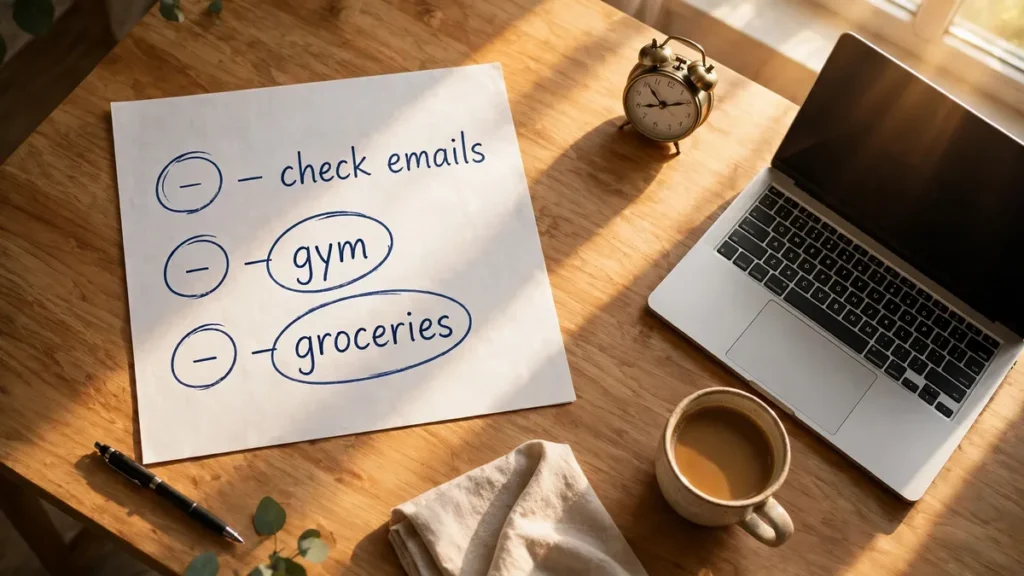
Look at the starred tasks and pick the three with the biggest impact: the ones that move a project forward, protect a relationship, or prevent a real problem. Ask one question about each task: “If I finish only this today, what changes?” The three tasks with the biggest answers are your top three. Write them at the top of a fresh page, numbered 1, 2, and 3. The rest of the starred tasks go into a second group: important, but not first. You will get to them after the top three.
Step 4: Sort the small tasks into a quick-wins pile
Everything left is either a quick task or a task that can wait. A quick task takes less than ten minutes: reply to a short email, approve a document, send a file. Put all of these in one pile for the gaps between your top three tasks. But they never come before a top-three task. Quick does not mean important. The rest go to the bottom of the page with a new date on them. Moving a task is not avoiding it. It is deciding when it gets done.
Step 5: Block your top three on the calendar
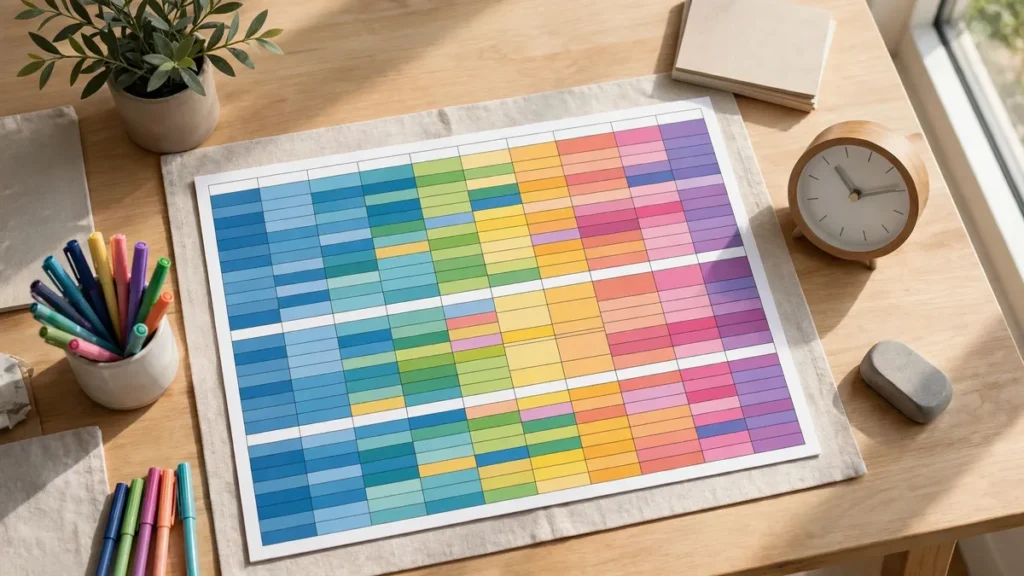
Put your top three on your calendar like meetings. Give the hardest one your best two hours, usually in the morning. A task on a to-do list is a wish. A task on a calendar is an appointment. If you want a simple way to build this into your whole day, a basic daily schedule gives your top three a home instead of letting them float around the list. Close your email while you work on the first task — email is where other people’s priorities arrive, and on a day when everything is due, those are the fastest way to lose yours.
Step 6: Work the list in order, and check in at lunch
Start with task number one and stay with it until it is done or until its block ends. Then move to task number two. In the gaps — while a file uploads, while you wait for a reply — clear two or three quick tasks from the pile. At lunch, look at the list again and cross off what is finished. If a top-three task is stuck, decide now whether to ask for help, move its deadline, or swap it with a second-group task.
Step 7: End the day with a five-minute reset
Before you close the laptop, spend five minutes on tomorrow. Cross off the finished tasks, move the unfinished quick tasks to tomorrow’s list, and write tomorrow’s top three at the top of a new page. Then stop.
A Real Example: A Beginner’s Overloaded Day in Austin, Texas
Maya, 31, works from home in Austin, Texas, as a customer success associate for a software company. Last Tuesday, she opened her laptop to 22 tasks due that day: four client emails, two reports, a presentation for a 3:00 meeting, a training video, expenses to file, and a dozen small requests from her team chat. She stared at the list for twenty minutes, answered the easiest email first, and by 10:00 she had cleared five small tasks without touching a single big one.
At 10:15, she stopped and tried the method above. She dumped all 22 tasks on paper and starred the ones with real deadlines: the presentation for the 3:00 meeting, a client report due by 5:00, and a renewal contract her manager needed by noon. Those were her top three. Everything else could move to Wednesday. She blocked 10:30 to 12:00 for the contract, 1:00 to 2:30 for the report, and 2:30 to 3:00 for the presentation, clearing six quick emails in the gaps. By 5:00, the report was sent. She finished the day with eight tasks still on the list, and she did not care, because the three that mattered were done. “The list did not get shorter,” she says. “It just got honest.”
Common Mistakes to Avoid
Starting with the easiest task. Easy tasks feel productive, and clearing five of them in an hour feels like progress. It is not, if the important work is still untouched at noon. Start with the task that matters most, even if it is the hardest one.
Treating every deadline as equal. “Due today” covers everything from a client delivery to a task you assigned to yourself. Check who set each deadline before you rank it.
Making a new list instead of working the old one. Some people reorganize their to-do list three times a day and call it planning. Rewriting the list is not doing the work. Write it once in the morning, sort it once, and then work it.
Saying yes to new tasks in the middle of the day. A day when everything is due is the worst day to accept new work. If someone asks for something, ask one question: “Can this wait until tomorrow?” Most of the time, it can.
Working without a finish line. If you never decide when the day ends, you will work until you are exhausted and still feel behind. Pick a stop time in the morning and protect it. The tasks that did not get done will be there tomorrow, and tomorrow you will start with a shorter list.
Quick Checklist
- I have dumped every task due today onto one piece of paper.
- I have starred the tasks with a real, hard deadline today.
- I have picked my top three by impact and written them at the top of a new page.
- My top three are blocked on the calendar, hardest one first.
- Quick tasks under ten minutes are in a separate pile for the gaps.
- Tasks that can wait have a new date written next to them.
- I will check the list at lunch and reset it for five minutes before I stop work.
FAQ
How do I prioritize my to-do list when everything is due today?
Write every task down, mark the ones with a real deadline today, and pick the three with the biggest impact. Do those three first, in order, and clear small quick tasks in the gaps. Move the rest to tomorrow with a new date.
What is the best method to prioritize tasks at work?
Sort by deadline and impact: hard deadlines first, then the tasks whose completion changes the most. The Eisenhower Matrix does the same thing in four boxes — urgent and important, important but not urgent, urgent but not important, and neither — but on a day when everything is due, picking a top three is faster.
How many tasks should I focus on in one day?
Three big tasks is the right number for most people. You can also clear several small tasks under ten minutes in the gaps between them. More than three big tasks in a day usually means some of them will slip, so it is better to choose three honestly than to pretend you will do six.
What do I do if my boss adds more work in the middle of the day?
Ask one question before you say yes: “What should I drop to make room for this?” It tells your boss the day is already full, and it lets them choose what matters most. Most managers will either move the new task to tomorrow or tell you which old task can wait.
Should I work late to finish everything on the list?
Almost never. Working late usually means you started the wrong tasks in the morning, and one late night does not fix that. Finish your top three, move the rest to tomorrow with real dates, and stop at your normal time.
Tomorrow morning, before you open your email, write your top three on a fresh page and block the hardest one on your calendar. One day of working in priority order is enough to feel the difference.